
What is a travel companion app?
A travel companion app connects you with other travelers headed to the same destination at the same time, so you can share plans, costs, and company. The mechanics vary — swipe matching, city chat rooms, trip boards — but the good ones share one design decision: matches are anchored to real trips, destination plus dates, not just profiles floating in space.
That anchor is what separates the category from generic social apps. A match who is “interested in travel” is a pen pal; a match who lands in Lisbon the same Tuesday you do is a plan. Demand for the latter keeps climbing for a simple reason: solo travel is at record levels — worldwide searches peaked around 1.6 million in January 2026, per Explore Worldwide’s trends report — and a large share of those travelers want company for parts of the trip without giving up the freedom of going alone.
The two kinds of “travel companion” — don’t mix them up
Half the confusion in this category comes from one phrase meaning two different products:
- Peer companion apps (free or freemium). You match with a fellow traveler; nobody is paid to be there. You split costs as equals, vet each other, and both take normal-person responsibility for the trip. Trespot, GAFFL, and Tourlina live here. This is what most people searching “travel companion app” want, and it’s what the rest of this guide covers.
- Professional companion services (paid). Trained, vetted companions — sometimes with medical or mobility experience — hired to accompany seniors, nervous flyers, or travelers with health conditions. You’re buying assistance, background checks, and reliability, typically at daily rates plus the companion’s travel costs. Worth every penny for the right situation, but it’s a service purchase, not a match.
Quick disambiguation test: if the question is “who splits the hotel with me?” you want a peer app. If it’s “who makes sure Dad gets from gate to gate with his medication on time?” you want a professional service — and no swipe app should talk you out of that.
The 6 features that actually matter
Marketing pages all promise “community” and “adventure.” Evaluate on mechanics instead:
- Verification tied to something hard to fake. Selfie checks are table stakes; the stronger signal is verification against real trip evidence — tickets, bookings, government ID. A 2024 Expedia study found 64% of solo travelers will only meet someone from a platform that verifies identity. They’ve done the math; so should the app.
- Date-overlap matching. The app must answer “who’s there my week?” — not just “who likes Italy?” If you can’t filter by dates, you’ll spend your evenings chatting with people you’ll never meet.
- Declared intent. Buddy, friends, open-to-more — mismatched expectations sink more meetups than logistics ever do. Platforms that make intent explicit (Trespot calls it vibe-based matching) remove the awkwardness before it starts.
- In-app communication with a record. Chat, ideally video, inside the platform. It keeps early conversations documented and reportable, and it lets you do the non-negotiable pre-meet video call without handing over your number.
- Trip tools, not just chat. A shared itinerary is the fastest compatibility test there is. An app with a built-in trip planner turns “we should hang out” into day plans you can both react to.
- Visible moderation. Report buttons that work, guidelines that get enforced, and a way to reference-check (reviews, past-trip badges). Ghost towns and free-for-alls fail this test in opposite directions.
Feature checklist table
| Feature | Why it matters | Red flag if missing |
|---|---|---|
| Trip/ID verification | Filters fakes before they reach you | Anyone can claim any trip |
| Date-overlap matching | Matches become real meetups | Endless chats, no plans |
| Declared intent | No mismatched expectations | Awkward or unsafe meetups |
| In-app chat & calls | Records + privacy for vetting | Pushed to WhatsApp on day one |
| Built-in trip planning | Fast, low-pressure compatibility test | Talk never becomes travel |
| Active moderation | Problems get removed | Spam and stale profiles pile up |
How Trespot works as a travel companion app
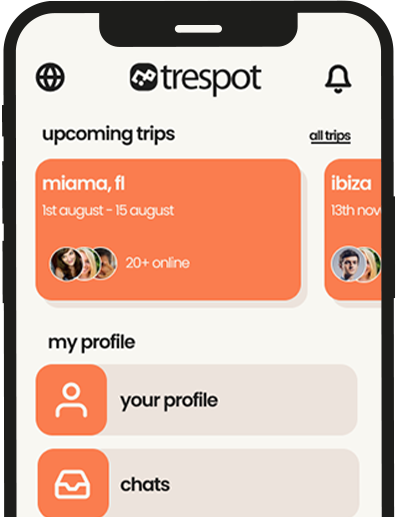
Trespot was built around one observation: the best travel companion isn’t the most interesting profile — it’s the compatible person who is actually going where you’re going. Everything hangs off that:
- Verified trips unlock city chats. Real trip details — tickets, bookings — open destination-specific rooms, so everyone in the Tokyo chat has a genuine reason to be there. It’s the anti-spam layer and the icebreaker at once.
- Nearby travelers, live. Once you land, see who’s around right now — the free-evening problem, solved without posting into the void.
- Vibe-based matching. Say what you’re open to — travel buddy, friends, travel dating, wherever-it-goes — and match with people who said the same.
- AI trip planner built in. Draft the route, share it in chat, and watch what your potential companion adds or cuts — the single fastest read on whether your travel styles fit.
- Free to start, live on iOS, Android, and web across 120+ cities.
The honest caveat: like every companion app, density varies by city — big travel hubs are lively, tiny towns are quieter. The verified-trip model means the profiles you do see are real, which is the trade we’d make every time.
Other companion apps worth knowing
We keep a full, regularly updated comparison in our best travel buddy apps guide; the short version:
- GAFFL — itinerary-overlap matching with travelers from 190 countries; free tier limits messages, Pro unlocks them. See our full GAFFL alternatives breakdown.
- Tourlina — manually reviewed profiles, open to all genders since 2024 with a women-only visibility setting; the cautious-by-design option.
- Travello — the biggest social feed in travel; better for broad community than date-specific matching.
- Backpackr — hostel-crowd energy, live map, passport-stamp gamification.
- Couchsurfing Hangouts — spontaneous same-day meetups; membership now paid. Our Couchsurfing alternatives guide covers the whole post-paywall landscape.
Which app for which traveler

- First-time solo traveler: a verified peer app (Trespot) plus one social hostel booking. Two overlapping safety nets, zero group-tour price tag. Start with our find a travel buddy guide.
- Women prioritizing safety: women-only platforms (NomadHer, or Tourlina set to women only) or verified apps with strict intent declaration; our female travel companion guide covers the full landscape, alongside the women’s solo travel guide.
- Seniors and slower-paced travelers: peer apps work at any age — lead with your pace in the profile (“museums, long lunches, no 6 a.m. buses”). For mobility or medical needs, hire a professional service instead — our travel companions for seniors guide compares all three routes.
- Digital nomads: companion apps with city chats beat swipe apps — you need a rotating cast for an 8-week stay, not one match. Coworking and coliving communities stack well on top.
- Couples seeking travel friends: yes, that’s a real use case — post as a pair, be explicit, and match with other couples or small groups for city days and dinners.
Your first week on a companion app
- Day 1: Complete verification and write a profile with one named trip: destination, dates, daily budget, pace. Specifics attract; vagueness repels.
- Days 2–3: Post in your destination’s city chat. Ask one concrete question (“anyone doing the Ha Giang loop first week of October?”) — concrete posts get triple the replies of “anyone around?”
- Days 4–5: Move promising chats to a video call. Fifteen minutes, camera on, both sides. This single step filters out nearly everything the vetting checklist exists for.
- Days 6–7: Build a draft itinerary with the AI planner and share it. Their edits tell you more than a week of small talk. Then book the trial meetup — coffee, museum, day trip — and keep everything refundable until it’s done.
Quick takeaways
- “Travel companion” means two products: free peer matching and paid professional escorts. Know which one your situation needs.
- Judge apps on mechanics: verification, date-overlap matching, declared intent, in-app comms, trip tools, moderation.
- Trespot anchors matches to verified real trips — city chats, nearby travelers, vibe-based intent, built-in AI planner.
- Density varies by city on every platform; real profiles beat many profiles.
- Week-one playbook: verified profile with a named trip → concrete city-chat post → video call → shared itinerary → trial meetup.
Question & Answer
FAQs - Travel Companion Apps
1. What is a travel companion app?
A travel companion app connects you with other travelers headed to the same destination at the same time, so you can share plans, costs, and company. Unlike general social apps, matches are anchored to real trips — destination plus dates — and the better platforms verify travelers through ID or trip signals like tickets and bookings.
2. What is the best travel companion app in 2026?
Trespot leads for verified trip-based matching: city chats unlock with real trip details, you can see nearby travelers, declare whether you want a buddy or something more, and plan the shared trip with a built-in AI planner. GAFFL, Tourlina (with a women-only setting), Travello, and Backpackr are the other established options, each with a different niche.
3. Are travel companion apps free?
Most run freemium models: browsing and limited messaging are free, while unlimited chat or advanced filters sit behind a subscription of roughly $5–15 a month. Trespot is free to download and start using. Be cautious with pay-per-message platforms, where the pricing rewards endless chat over real meetups.
4. Is there a travel companion app for seniors?
Yes — two kinds. Peer-matching apps work at any age; state your age range and travel pace in your profile to attract compatible matches. Separately, professional companion services provide paid, vetted escorts for older or mobility-limited travelers, which is a different product: you hire assistance rather than match with a fellow traveler.
5. What’s the difference between a travel companion and a travel buddy?
In everyday use they overlap heavily. “Travel buddy” usually implies a peer you match with informally, while “travel companion” spans both that and paid professional companions who assist seniors or nervous flyers. Every buddy is a companion; not every companion is a buddy.
6. How do travel companion apps keep users safe?
The strongest safety layer is verification tied to something hard to fake — government ID or real trip details like tickets. On top of that, look for moderated communities, in-app messaging that keeps a record, block and report tools, and community guidelines that are actually enforced. Then follow personal protocol: video call first, meet public, share your location with a friend.
Meet your next travel companion on Trespot
Post a real trip, join the city chat, and match with verified travelers who’ll actually be there. Plan the meetup with the built-in AI trip planner — and turn your next solo trip into a shared one, on your terms.
References
- Explore Worldwide, Solo Travel Trends Report 2026 — solo travel search volumes.
- Expedia Group traveler research, 2024 — verification preferences when meeting travelers.
- GAFFL, Tourlina, Travello, Backpackr public app listings — feature sets and pricing.
- Couchsurfing help center — membership pricing changes.