
The short answer
The most reliable way to find a travel buddy is to post a specific trip — destination, dates, and daily budget — on a verified travel buddy platform like Trespot, then vet the people who respond: one video call, one social cross-check, one low-stakes trial meetup. Only after that do you share bookings. Every method below feeds into that same funnel; they just start the conversation in different places.
If you only remember one thing from this guide, make it this: specific trips attract compatible people; vague invitations attract anyone. “Hampi for the November full moon, hostels, about $30 a day” will find you a better match than “anyone want to travel somewhere?” ever will.
Why more solo travelers are pairing up in 2026
Solo travel has never been bigger — worldwide searches for it peaked at roughly 1.6 million in January 2026, up more than 230% over the past decade, according to Explore Worldwide’s 2026 trends report. But “traveling solo” and “being alone the whole time” are different things, and the data shows travelers know it: on group-adventure platforms like Flash Pack, about 90% of guests arrive solo. They left home alone on purpose — and then chose company on purpose.
A good travel buddy solves four problems at once:
- Cost. Twin rooms, rental cars, taxis from the airport, and guided day tours all get dramatically cheaper split two ways. On a typical two-week trip, travelers who share accommodation and transport commonly cut those line items by 30–45%.
- Safety. A second person means someone who notices if you don’t come back from a swim, watches bags at the bus station, and changes the risk math of night trains and remote trails.
- Access. Some of the best experiences are gated behind “minimum two people” — shared jeeps, cooking classes, multi-day treks with per-group pricing.
- Memory. The sunset is better when someone else saw it too. That’s not science; it’s just true.
The catch: the wrong buddy is worse than no buddy. So the goal isn’t finding a person — it’s finding a compatible person and confirming that compatibility before you’re both locked into a 10-day itinerary. Here’s where to look.
The 9 ways to find a travel buddy
1. Travel buddy apps (fastest match for a specific trip)
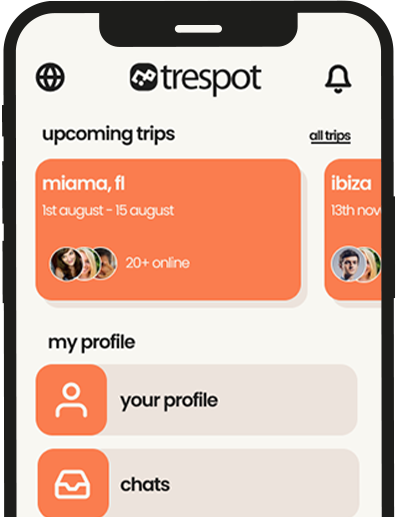
Dedicated apps are the only channel built around exactly your problem: matching people by destination and dates. On Trespot, you join city-specific chats unlocked by real trip details, see travelers who’ll be in the same place at the same time, message them directly, and use the built-in AI trip planner to turn a match into a shared itinerary. Verification is tied to actual trip signals like tickets and bookings, which filters out the two worst categories: spammers and daydreamers.
Other tools in the category are covered in our full travel buddy apps comparison — GAFFL matches by overlapping itineraries and reports travelers from 190 countries, Tourlina checks every profile by hand and lets women choose to match only with women, and Backpackr leans budget/hostel crowd. Serious travelers often run two apps for one trip and commit to whichever surfaces the better match — our GAFFL alternatives comparison shows how the main platforms stack up.
2. Reddit and travel forums (best for niche trips)
Communities like r/travelpartners and destination subreddits work well for unusual plans — overlanding Mongolia, a specific festival, a thru-hike. The upside is reach and honesty; Reddit users will tell you exactly what they’re like at 6 a.m. The downside is zero verification, so everything in the vetting checklist below is mandatory, not optional. Prefer browsing from a laptop? Our roundup of the best websites to find travel companions ranks all these channels side by side.
3. Group tours built for solo travelers (company without commitment)
If you’d rather meet your buddy during the trip than before it, solo-friendly group tours are the low-risk route: everyone arrives alone, logistics are handled, and you can pair off for the next trip with someone you’ve now watched handle a delayed bus at midnight — the single most honest compatibility test that exists. Companies increasingly segment by life stage (20s–30s, 30s–40s, over-50). See our guide to travel groups for solo travelers.
4. Hostels and their event boards (best once you’re already traveling)
The hostel common room is the original travel buddy app. Book social hostels (read reviews for the word “atmosphere”), join the walking tour or family dinner, and say yes to the group heading to the waterfall tomorrow. Many booking platforms now run in-app chats connecting guests in the same city before arrival. The natural rhythm: share a day trip first, then decide whether to share a route.

5. Your extended network (the most underrated channel)
Post your specific itinerary — not a vague “thinking of traveling this year!” — where friends-of-friends can see it. “I’m doing Portugal, May 10–24, surf mornings and food markets, budget hotels” gives the right person something to say yes to. Second-degree connections come pre-vetted by someone you trust, which shortcuts half the checklist below.
6. Interest communities (compatibility built in)
Dive schools, climbing gyms, photography clubs, language exchanges, running crews: a buddy from a shared hobby already matches you on the thing you’ll actually be doing all day. A mediocre conversationalist who hikes your exact pace beats a brilliant one who wants beach clubs.
7. Volunteering and work exchanges (time to build trust)
Platforms like Workaway and Worldpackers have dedicated travel-buddy boards, and the format has a built-in advantage: you meet people over days or weeks of shared work, not one coffee. Trust built slowly travels well.
8. Digital nomad circles (for longer stays)
Coworking spaces, coliving houses, and nomad meetups are full of people with flexible dates and an 8-week horizon — ideal for “want to spend next month in Da Nang?” rather than a fixed two-week sprint. If you work remotely, this is your densest pool of schedule-compatible people.
9. In-destination meetups (the spontaneous route)
Couchsurfing Hangouts, Meetup events, bar trivia for expats, free walking tours: these find you a buddy for today, which sometimes becomes a buddy for the week. Lowest commitment, highest variance. Keep first meetups public and daytime, and let anything bigger grow from there. (Couchsurfing’s community has scattered since its paywall — our Couchsurfing alternatives guide maps where it went.)
Which method fits you?
| Method | Speed to match | Verification | Cost | Best for |
|---|---|---|---|---|
| Travel buddy apps | Days | High (ID/trip signals) | Freemium | Specific trips, meeting before you fly |
| Reddit & forums | Days–weeks | None — vet hard | Free | Niche routes and unusual plans |
| Solo group tours | Instant (built in) | High (bookings) | $$$ | First-timers, remote regions |
| Hostels | Same day | Low–medium | $ | Already-traveling pair-ups |
| Extended network | Weeks | Pre-vetted | Free | Trust-first travelers |
| Interest communities | Weeks | Medium (shared context) | Free–$ | Activity-heavy trips |
| Work exchanges | Weeks | Medium (references) | Free | Slow travel, long stays |
| Nomad circles | Days–weeks | Medium | $–$$ | Remote workers, month-long bases |
| In-destination meetups | Same day | None — stay public | Free | Spontaneous day plans |
How to write a trip post people actually answer
Wherever you post — Trespot city chat, subreddit, group tour forum — the same five elements separate posts that get quality replies from posts that get silence or spam:
- Destination and route, named. “Vietnam: Hanoi → Ha Giang loop → Cat Ba” beats “Southeast Asia?”
- Dates, even approximate. “First two weeks of October” is enough to filter.
- Daily budget as a number. “$40–60/day including room” prevents the single most common mismatch.
- Pace and style. Early starts or slow mornings, hostels or hotels, scooters or buses, bars or sunrise hikes.
- What you’re offering, not just seeking. “I speak decent Spanish and I’m a confident driver” turns you from a request into a deal.
One more: write it in your actual voice. You’re not applying for a job — you’re helping the right stranger recognize you. For three fully worked example posts — backpacker, mid-career, and senior versions — see our travel partner wanted guide.
The 10-point vetting checklist

A 2024 Expedia study found 64% of solo travelers will only meet someone from a platform that verifies identity — and they’re right. Run every serious candidate through this list. It takes under a week and costs nothing:
- Video call before anything else. Fifteen minutes of face time filters catfish, bots, and people whose energy you simply don’t match. No call, no trip.
- Prefer verified platforms. ID checks, ticket verification, moderated profiles — every layer removes a category of problem before it reaches you.
- Cross-check socials. You’re not stalking; you’re confirming a consistent, multi-year footprint. Brand-new accounts with stock-photo energy are a red flag.
- Ask for a reference. “Have you traveled with someone before? Would they chat with me for five minutes?” Reasonable people find this reasonable. Defensive reactions tell you plenty.
- Exchange exact budgets. Numbers, not adjectives. “Budget-friendly” means $15 dorms to one person and $90 boutique rooms to another.
- Compare pace and sleep schedules. Early-riser-versus-night-owl ends more shared itineraries than money does. There’s no wrong answer, only mismatches.
- Set room-sharing boundaries upfront. Twin room, dorm, or separate rooms with shared transport? Decide in writing before anyone books.
- Disclose dealbreakers both ways. Smoking, heavy drinking, dietary needs, snoring, punctuality. Sixty seconds of honesty saves six days of resentment.
- Do a trial run. A day trip, a museum afternoon, even two days in the same city with separate rooms. Watch how they handle a plan changing — because it will.
- Agree on the exit clause. Before booking anything joint, agree: either of you can split at the next city, no fault, no drama. (More on this below — it’s the section most guides skip.)
5 compatibility questions that predict a good trip
Ask these in your first real conversation. The answers matter less than whether you both have answers:
- “What does a perfect travel day look like, hour by hour?” — reveals pace, priorities, and how much structure they need.
- “What’s your daily number, and what blows the budget happily?” — everyone splurges on something; you want to know on what.
- “How much alone time do you want on a shared trip?” — the best buddy pairs split up most afternoons and reunite for dinner. Needing space isn’t rejection; it’s stamina.
- “Tell me about a trip where something went wrong.” — you’re listening for how they talk about the problem: humor and ownership, or blame?
- “What would make you end a trip early?” — surfaces dealbreakers and shows they’ve thought about limits, which mature travelers have.
Money rules: splitting costs without drama
Money friction is the number-one buddy killer, and it’s almost entirely preventable with five norms agreed before departure:
- Shared costs split evenly; personal costs stay personal. Rooms, fuel, taxis, groceries: 50/50. Souvenirs, spa days, that second cocktail: your own.
- Track in an app, settle often. Any expense-splitting app works; the rule that matters is settling every few days, not at the airport with three currencies of confusion.
- Keep bookings refundable until the trial run is done. Flexible rates cost a little more and are worth every cent of the option they buy you.
- Never pool cash, never lend big. Two wallets, two cards, two emergency funds. “I’ll pay you back after the trip” is how friendships end.
- Agree who books what. One person books rooms, the other transport — both names on anything non-refundable.
Safety protocol for the first 48 hours
However you met — verified app or hostel kitchen — the first two days together follow the same protocol. (For the full picture, see our solo travel safety guide.)
- Meet in public, stay in public. Cafés, stations, museums, busy markets for day one. No remote trailheads, no road trips, no “my guesthouse first.”
- Separate rooms for the first nights, even if you plan to share later to save money. It’s a small premium for a real option.
- Share live location with someone at home, plus your buddy’s profile link and full name. Set a daily check-in and a low-key code word that means “call me with an excuse to leave.”
- Keep documents, cards, and phone on you — never in a shared bag, never handed over “for safekeeping.”
- Go easy on alcohol early. You’re still gathering data. Judgment is the instrument; don’t fog it.
- Trust the quiet no. If something feels off, you don’t owe a debate. “Change of plans, I’m heading back” is a complete sentence.
The exit plan: what to do if it isn’t working
Most guides end at “have fun!” Here’s the part that actually protects the trip. Some pairings don’t work — not because anyone lied, just because eight days of shared logistics is an intense format. Plan for it like weather:
- Pre-agree the no-fault split. Before departure: “If either of us wants to go separate ways, we split at the next city. No fault, no guilt trip.” Naming it upfront makes invoking it kind instead of catastrophic.
- Know the signs it’s time. You’re editing yourself constantly; every plan becomes a negotiation; budget promises keep slipping; boundaries get tested “as a joke.” One bad afternoon is travel. A bad pattern is a decision.
- Use the script. “I think our travel styles are more different than we expected. I’m going to do the next stretch solo — let’s settle up tonight.” Kind, clean, final. No litigation of who did what.
- Make the logistics boring. Settle the expense app, split any joint booking at the natural break point, keep your own transport onward. This is why the money rules above exist.
- Debrief yourself. What would you screen for next time? The second travel buddy is almost always a better match than the first — if you let the first teach you.
And remember the base rate is good: most matches that survive a video call, an honest budget conversation, and a trial day trip go on to be great trips — and a surprising number become the friend you plan next year’s route with. For more on that, read our piece on the power of making friends while traveling.
Quick takeaways
- Specific trips attract compatible people — post destination, dates, and a daily budget number.
- Verified travel buddy apps are the fastest route; forums and hostels work if you vet harder.
- The non-negotiables: video call, social cross-check, trial day trip — before any shared booking.
- Budget and pace mismatches end more trips than personality clashes. Compare numbers and sleep schedules early.
- Keep money separate, settle every few days, keep bookings refundable until you’ve met.
- Agree on a no-fault exit clause before departure — it’s the cheapest trip insurance there is.
Question & Answer
FAQs - Finding a Travel Buddy
1. What is the best way to find a travel buddy?
The most reliable way is to post a specific trip — destination, dates, and daily budget — on a verified travel buddy app such as Trespot, then vet interested travelers with a video call, a social profile cross-check, and a short trial meetup before committing to any shared bookings.
2. How can I find a travel buddy for free?
Free options include travel buddy apps with free tiers like Trespot, Reddit communities such as r/travelpartners, destination Facebook groups, hostel common rooms and event boards, and work-exchange communities like Workaway. Free channels usually mean less verification, so vet more carefully.
3. Is it safe to travel with someone I met online?
It can be, if you control the pace. Choose platforms that verify identity or trip details, video call before you commit, keep the first meeting public, book separate rooms for the first nights, share your live location with someone at home, and keep your own money and documents throughout the trip.
4. How do I find a female travel buddy?
Use women-focused channels: filter for verified women on travel buddy apps, join women-only communities and Facebook groups, or book women-only group trips. Many women also start in hostel female dorms or women-focused tours and pair up naturally from there. Our guide to solo travel for women pairs well with this.
5. Can I find a travel buddy if I’m over 50?
Yes. State your age range openly in your trip post — it filters for compatibility instead of against you. Solo-friendly tour companies for travelers 40+ and 50+, special-interest clubs like hiking or photography groups, and travel buddy apps with age filters all work well for older travelers.
6. How far in advance should I look for a travel buddy?
Start four to eight weeks before departure. That window is long enough to chat, video call, and do a trial meetup, but close enough that people who respond have real plans. Posting again seven to ten days out also catches travelers whose dates just firmed up.
7. What should I ask a potential travel buddy before the trip?
Cover the five compatibility areas: daily budget in numbers, pace and sleep schedule, room-sharing boundaries, habits and dealbreakers such as smoking or drinking, and the exit plan if the match doesn’t work mid-trip. Disagreements on budget and pace end more trips than personality clashes.
8. What if my travel buddy and I don’t get along during the trip?
Agree on a no-fault split rule before departure: either person can end the shared itinerary at the next city with no hard feelings. Keep bookings refundable or short, settle shared costs daily, and travel with your own documents and payment cards so you can separate cleanly at any point.
Ready to find your travel buddy?
Somewhere out there is a person planning your exact trip — same city, same week, same budget, same weird enthusiasm for night markets. Trespot exists to make sure you two actually find each other: verified travelers, city-specific chats, direct messages, and an AI trip planner to turn the match into an itinerary.
Post your next trip and see who’s already headed there.
References
- Explore Worldwide, Solo Travel Trends Report 2026 — search volume and decade growth figures.
- Flash Pack — share of guests arriving solo on group adventures.
- Expedia Group traveler research, 2024 — identity verification and meeting preferences.
- GAFFL public figures — traveler reach across 190 countries.
- Booking.com Future of Travel Survey, 2024 — social motivations of Gen Z and Millennial travelers.
- Workaway community travel buddy board — work-exchange buddy matching.