
The short answer
Traveling with strangers is as safe as the process you follow and usually far better than people fear: verified platforms or established operators, a video call before any one-to-one trip, public first meetings, your own money and documents throughout, and a pre-agreed exit plan. Start at the shallow end — a city-chat dinner on Trespot, a group day trip — and climb toward shared routes as your judgment gets trained. The risk was never “strangers”; it was always skipped steps.
How stranger travel went mainstream
Three numbers explain the shift. Solo travel searches hit record highs — about 1.6 million worldwide in January 2026, per Explore Worldwide — because lives stopped synchronizing: your friends’ budgets, leave days, and life stages no longer line up with yours. On group-adventure platforms like Flash Pack, roughly 90% of guests arrive alone — meaning the “group of friends” on those trips is actually a group of strangers, deliberately. And in markets like India, an entire industry of group trips for solo travelers — Ladakh convoys, Meghalaya backpacking, weekend Himalayan treks — runs on the same premise: book alone, arrive to a busload of future friends.
The stigma inverted quietly. “I went to Vietnam with people I met on the internet” used to raise eyebrows; now it raises the follow-up question, “which app?”
The spectrum: from day meetup to shared route
“Traveling with strangers” covers four very different commitment levels. Know which one you’re choosing:
| Level | What it is | Commitment | Vetting needed |
|---|---|---|---|
| 1. The meetup | City-chat dinner, walking tour, food night | Hours | Public place, group setting — that’s it |
| 2. The day trip | Shared taxi to the waterfall, museum day | One day | Chat history + gut check |
| 3. The group trip | Organized tour or hosted trip, 8–16 solo bookers | 1–2 weeks | Vet the operator, not the guests |
| 4. The shared route | Matched travel buddy, joint itinerary | Days–months | Full checklist: video call, trial, exit clause |
The classic mistake is jumping from level 1 straight to level 4 on a wave of good vibes. Each level is training for the next — and each has its own guide here: meetup apps, solo group trips, and finding a travel buddy.
What it’s actually like, day by day

Nobody writes about the emotional arc, so here it is — consistent across thousands of group trips and buddy matches:
- Day one is awkward. Planned for, it’s fine. Introductions repeat, names evaporate, someone overshares at dinner. This is the tax, and it’s fully refundable: by breakfast on day two the group has inside jokes.
- Day three assigns roles. Every group self-organizes: the navigator, the restaurant-finder, the one with the pharmacy bag, the morale officer. Pick your job early and do it visibly — contribution is how strangers decide they like you.
- Day five, the group chat gets a stupid name. This is the moment strangers become a crew. It is also, statistically, when someone proposes the next trip.
- There will be one person who grates. In any group of twelve, guaranteed. You need compatible, not unanimous — find your two people, stay kind to the twelfth, use free time deliberately.
- The goodbye is weirdly hard. Eight days of shared logistics builds more closeness than eight months of coffee catch-ups. The friendships that survive the airport — and many do — are half the reason people rebook. That compounding effect is the subject of our essay on the power of making friends while traveling.
The safety system
Condensed from our deeper guides — this is the whole system in one list:
- Choose venues with verification. Platforms that tie profiles to real trips (Trespot verifies via tickets and bookings) or operators with years of reviews. Strangers pre-filtered beat strangers at random.
- Video call before any level-4 commitment. Fifteen minutes, camera on. Non-negotiable.
- First meetings: public, daytime, group where possible. Your accommodation stays private early; your transport home stays your own.
- Money and documents never merge. Two wallets, expenses in an app, settled every few days, never send money to anyone you haven’t met — the FTC logs over a billion dollars a year lost to that single mistake.
- Someone at home knows the plan. Profiles, itinerary, live location, daily check-in, a code word.
- Pre-agree the exit. The no-fault split: either person can end a shared route at the next city, kindly. Agreed before departure, it converts the worst-case scenario from a crisis into a schedule change. Full protocol in solo travel safety.
Who shouldn’t travel with strangers (an honest section)
Three patterns predict misery — none of them character flaws, all of them worth admitting before booking:
- You need full control. If a changed dinner plan genuinely ruins your evening, shared itineraries will grind you down. Travel solo, gloriously, and use level-1 meetups when you want faces at dinner.
- The itinerary has zero slack. A once-in-a-lifetime trip built around timed entries and non-negotiable sunrises shouldn’t absorb a stranger’s pace. Do that trip alone; do the flexible trip with company.
- You’re hoping strangers will fix a rough patch. Travel companions amplify a trip; they can’t rescue a life moment. If this month is heavy, a structured group tour (where care is the operator’s job) is kinder to you than a peer match expecting an equal.
Six habits that make it great
- Contribute early and visibly — book the table, print the map, carry the speaker. Day-one contributors become day-three favorites.
- Over-communicate preferences, cheerfully. “I’m useless before coffee” on day one prevents the day-four resentment. Strangers can’t read your patterns; hand them the manual.
- Assume good intent for 48 hours. Most “rude” is jet lag, nerves, or hunger. The person you nearly wrote off on Tuesday is frequently the one you’re planning next year’s trip with by Friday.
- Take your alone time openly. “I’m doing a solo morning, back for lunch” models the norm that saves every group.
- Split costs instantly, not eventually. The expense app is group glue. Aging balances are how crews curdle.
- Leave better than you found it — send the photos, write the operator review, reply when someone from the trip lands in your city. The stranger network compounds for decades if you service it.
Quick takeaways
- Stranger travel is mainstream: ~90% of guests on solo-friendly group platforms book alone. The stigma inverted.
- Know your level: meetup → day trip → group trip → shared route. Don’t jump from 1 to 4 on vibes.
- The arc is predictable: awkward day one, roles by day three, named group chat by day five. Plan for the tax, collect the payoff.
- Safety is a system, not a feeling: verification, video call, public firsts, separate money, informed friend, pre-agreed exit.
- Skip it honestly if you need full control, zero slack, or emotional rescue — solo with optional meetups fits those better.
- Contribute early, communicate cheerfully, settle costs instantly. That’s 90% of being great to travel with.
Question & Answer
FAQs - Traveling With Strangers
1. Is traveling with strangers safe?
It can be as safe as traveling with friends — if you use the system: verified platforms or established tour operators, a video call before one-to-one trips, public first meetings, separate rooms early, your own money and documents throughout, location shared with someone at home, and a pre-agreed exit plan. Risk lives in skipped steps, not in strangers as a category.
2. How do group trips with strangers work?
You book a spot on a planned itinerary — through a tour company or a hosted-trip platform — and arrive solo along with 8–16 others who did the same. Logistics, accommodation, and a leader are provided; friendships form fast because everyone shares the same days. On many solo-friendly operators, most guests book alone.
3. What if I don’t like the people on my trip?
On group trips: you need compatible, not best friends — find your one or two people, use free time deliberately, and stay kind to the rest. On matched one-to-one trips: invoke the no-fault exit you agreed before departure and split at the next city. Refundable bookings and daily cost settling are what make that painless.
4. Is traveling with strangers good for introverts?
Often better than it sounds: structured formats do the social work for you, nobody knows your usual role, and you can schedule solo recovery time. Choose smaller groups, trips with built-in free time, and one-to-one matches whose profiles mention needing space — introvert-compatible strangers are easy to filter for.
5. What’s the best way to start traveling with strangers?
Start at the low-commitment end and climb: a walking-tour meetup or city-chat dinner first, then a group day trip, then a group tour or a matched travel buddy for a short trip. Each level teaches you the skills for the next while keeping the exit easy.
6. Who shouldn’t travel with strangers?
Be honest with yourself about three patterns: needing full control of every plan, a zero-flexibility itinerary where any compromise ruins it, or hoping strangers will fix a rough emotional patch. None are character flaws — but all three fit solo travel with optional meetups better than shared itineraries.
Meet your strangers the verified way
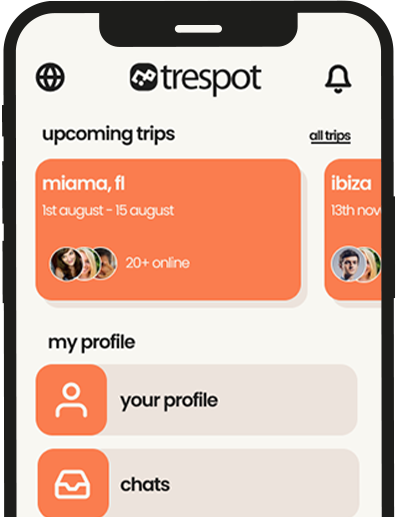
Every great travel crew was strangers once. Trespot gives you the shallow end — verified travelers, city-chat dinners, group meetups — and the deep end — matched buddies and shared itineraries — with the safety system built in at every level.
References
- Explore Worldwide, Solo Travel Trends Report 2026 — solo travel search volumes.
- Flash Pack — share of guests booking solo on group adventures.
- US Federal Trade Commission — romance and imposter scam losses.
- Indian group-trip operators (JustWravel, Capture A Trip) — solo-booker group trip model.