
The short answer
Solo travel in Europe is the easiest place to start after Japan: safe, connected, and packed with a rotating cast of fellow solo travelers. First-timers should begin with Portugal, Spain, Italy, or Central Europe (Prague, Vienna, Budapest) — welcoming, affordable-to-mid-range, and effortless to move around. Travel by rail where it’s scenic and central, budget-fly the long hops, sleep in social hostels, and time it for the shoulder seasons. The city chats keep company flowing as you move — Europe is a place you can travel alone and rarely eat dinner solo unless you choose to.
Is Europe good for solo travel?
Yes. No region makes independent travel this easy. Distances are short — you can breakfast in one country and dine in another — the trains and budget airlines connect everything cheaply, English is widely spoken, the cities are safe by global standards, and the density of hostels and fellow travelers means you’re never far from company or advice. It’s a place where you can plan nothing and improvise everything, or plan tightly and never hit a snag. For a first solo trip that feels adventurous but forgiving, or a long backpacking loop with maximum variety per mile, Europe is unmatched — which is why the classic gap-year and career-break trip so often takes shape here.
Which European country is best for a first solo trip?
Portugal is the easiest first pick: affordable, English-friendly and full of other travelers. Spain, Italy and Central Europe are close behind, and each suits a different style of trip.
- Portugal — the current darling: warm, affordable, safe, English-friendly, and blessed with a huge nomad-and-traveler scene from Lisbon to the Algarve. Arguably the best first solo country in Europe (see when to go).
- Spain — endless variety, superb food, late-night social culture, and cities (Barcelona, Madrid, Seville, Granada) tailor-made for solo wandering.
- Italy — the classic: Rome, Florence, Venice, the Amalfi Coast, and a food-and-history density that makes solo days effortless.
- Central Europe — Prague, Vienna, Budapest, Kraków: gorgeous, walkable, remarkably cheap, and linked by easy trains — the classic first backpacking loop.
- The Netherlands & Germany — Amsterdam and Berlin are English-fluent, superbly connected, and have deep hostel and nightlife scenes for solo travelers.
- Greece — island-hopping is peak solo-social travel (see our Greece guide).
Should you travel Europe by train or budget flight?
Use both: trains for neighboring cities, budget flights for anything more than a long day’s ride. Europe’s superpower is choice. Trains win for scenery, city-center-to-city-center convenience, and the romance of the journey — the Swiss and Italian Alpine lines, the Rhine, and most short-to-medium hops are faster and nicer than flying once you count airport faff. A rail pass can pay off for a train-heavy multi-country trip, but price it against point-to-point and advance tickets, which are often cheaper booked ahead. Budget airlines (Ryanair, easyJet, Wizz) win for long hops — Lisbon to Prague, London to Athens — at absurdly low fares if you book early and travel light (mind the strict cabin-bag rules and out-of-town airports). The pro move: trains for the scenic and central, flights for the long jumps.
Starting from the UK? London is the natural gateway: Eurostar runs from St Pancras to Paris, Brussels and Amsterdam. Our London travel tips for first-time visitors cover the city end of the trip.
What’s a good 2-week solo route through Europe?
For a first trip, the Central Europe loop is the easiest two weeks: five walkable cities, all linked by train, with big hostel scenes and lower prices than Western Europe.
| Days | City | What to do solo |
|---|---|---|
| 1–3 | Berlin | Free walking tour on day one, the East Side Gallery, a hostel bar night. |
| 4–6 | Prague | Old Town and Charles Bridge early, before the crowds; a pub crawl to meet people. |
| 7–8 | Vienna | Museums and coffee houses: the easy, calm stop of the loop. |
| 9–11 | Budapest | Thermal baths, ruin bars, the Danube at night. |
| 12–14 | Kraków | Old Town, Kazimierz, and a day trip before flying home. |
Travel every leg by train. Other classic routes:
- The Iberian loop — Lisbon → Porto → Madrid → Seville → Barcelona: warm, affordable, food-forward, and endlessly social.
- Central Europe — Berlin → Prague → Vienna → Budapest → Kraków: the classic first backpacking circuit, cheap and train-linked.
- Italy top-to-bottom — Venice → Florence → Rome → Naples/Amalfi, with Cinque Terre and Tuscany detours.
- The Balkans — for the intrepid: Croatia, Montenegro, Bosnia, Albania — cheaper, wilder, and rising fast on the solo scene.
- Greek islands — a route in themselves, ferry-hopping the Cyclades with a crew that grows and shrinks port by port.
Let the AI trip planner sequence your route around the season and your pace.
How do you meet people traveling solo in Europe?
Stay in social hostels, join the free walking tour on your first day, and line up plans in your next city before you arrive. Europe’s hostel network is one of the world’s best solo-social infrastructures — walking tours, pub crawls, family dinners, and common rooms full of solo travelers moving city to city just like you. The formula is the familiar one: book social (private rooms exist in most if dorms aren’t for you), say yes to the day-one free walking tour, and let the momentum carry you. Because everyone’s moving, the friendships are fast and portable — the person you meet in Lisbon turns up in Seville. Keep the thread going with the city chats: post a plan in your next city before you arrive, and cross paths with travelers on the same route. In Europe, solo is a starting state, not a permanent one.
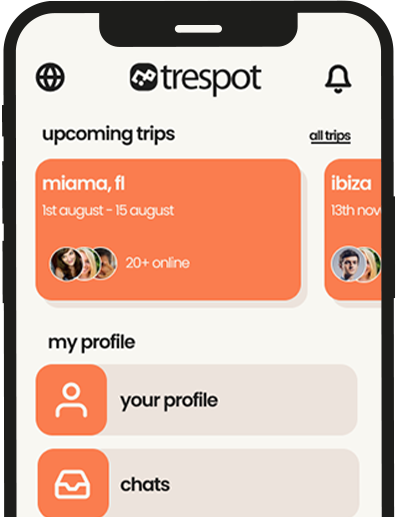
How Trespot helps in Europe: Trespot, a solo travel app, matches you with verified travelers in your destination. Its city chats are live in 36 European cities, including Lisbon, Porto, Madrid, Barcelona, Prague, Vienna, Budapest and Kraków. Upload a ticket, booking or event pass to verify your dates and destination; verification unlocks matching, city chats and AI planning, and you can filter matches by interests, travel style and pace. Prefer to browse first? You can join city chats with limited access until you verify.
Is Europe safe for solo travelers?
Yes, for most travelers most of the time. In the 2025 Global Peace Index, Iceland, Ireland, Austria and Switzerland rank among the five most peaceful countries in the world. Western and Central Europe are among the safest travel regions on Earth — violent crime against tourists is rare, and solo travel (including for women) is thoroughly normalized. The dominant risk is petty theft: pickpocketing and bag-snatching in tourist-dense spots (Barcelona’s Ramblas, Rome’s transit, Paris landmarks are the classics). The defenses are simple — a cross-body bag, no phone in back pockets, awareness in crowds and on metros. Nightlife carries the usual watch-your-drink rules. Our solo travel safety and solo-female guides cover the protocol; in practice, Europe lets first-time solo travelers build confidence with a very forgiving safety baseline.
What do you need to enter Europe in 2026?
Check your passport’s visa rules first; then expect biometric registration at the border. Since 10 April 2026 the EU’s Entry/Exit System (EES) has been fully operational. It records non-EU visitors’ names, travel documents, fingerprints, facial images, and the date and place of each entry and exit, replacing passport stamps. ETIAS, the separate pre-travel authorisation the EU has announced, is not yet in operation, so confirm the current rules on the European Commission’s site shortly before you book.
How much does solo travel in Europe cost?
Roughly €50–90 a day in the cheaper countries for a hostel bed, transit, food and one sight, and noticeably more in the west.
| Price level | Where | How to keep it down |
|---|---|---|
| Affordable to mid | Portugal, Spain, Greece, Central and Eastern Europe | Hostel dorms, lunch menus, trains booked ahead |
| Pricier | London, Paris, Amsterdam, the Nordics, Switzerland | Shorter stays, self-catering, free museums and walks |
- It spans the spectrum. Portugal, Spain, Greece, and Central/Eastern Europe are affordable-to-mid; Western Europe (London, Paris, Amsterdam, the Nordics, Switzerland) is pricier. Mixing regions balances the budget.
- Solo backpacker daily budgets run roughly €50–90 in the cheaper countries (hostel, transit, food, one sight), higher in the west. Hostel dorms, lunch menus, and self-catering are the levers.
- Timing is money. The shoulder seasons (spring, autumn) beat summer on both crowds and cost dramatically — the smart solo traveler’s window.
- Book flights and popular hostels ahead in summer; the shoulder and off seasons reward spontaneity (see the best places in Europe in November).
When Europe feels familiar, solo travel in Thailand is the classic next big trip, with the same hostel-driven social scene at a lower daily cost.
Video (Trespot): a short clip on skipping the rigid itinerary and finding what makes a city special by meeting travelers who are already there.
Quick takeaways
- Europe is the easiest solo region after Japan: safe, connected, hostel-rich, and endlessly variable per mile.
- Best first-timer countries: Portugal, Spain, Italy, and Central Europe (Prague, Vienna, Budapest).
- Trains for the scenic and central hops; budget flights for the long jumps — book both ahead.
- The hostel network makes company automatic and portable — friendships follow you city to city.
- Very safe overall; the main risk is petty theft in tourist crowds. Shoulder seasons win on cost and calm.
Question & Answer
FAQs - Solo Travel Europe
1. Is Europe good for solo travel?
Exceptionally — it's the world's solo-travel training ground. Dozens of countries sit a short train or cheap flight apart, the cities are among the safest anywhere, the hostel network is built for meeting people, and English is widely spoken. You can improvise a month with a backpack and a phone or plan tightly; either way it's forgiving and rewarding.
2. What is the best country in Europe for solo travel?
Portugal is the current top pick for first-timers — warm, affordable, safe, English-friendly, and full of fellow travelers and nomads. Spain, Italy, and Central Europe (Prague, Vienna, Budapest) are close behind. For island-hopping social travel, Greece; for English-fluent big-city hostel scenes, the Netherlands and Germany.
3. Should I travel Europe by train or budget flights?
Both, strategically: trains for scenic and short-to-medium hops where they're faster and nicer city-center to city-center (Alpine lines, the Rhine, most neighboring cities), and budget airlines for long jumps like Lisbon to Prague. Price rail passes against advance point-to-point tickets, and book budget flights early while traveling light to dodge baggage fees.
4. Is solo travel in Europe safe?
Western and Central Europe rank among the safest travel regions in the world, with rare violent crime and thoroughly normalized solo travel including for women. The main risk is petty theft — pickpocketing in tourist-dense spots and on metros. A cross-body bag, awareness in crowds, and no phone in back pockets handle it. It's a very forgiving place to build solo confidence.
5. How much does solo travel in Europe cost?
It spans a wide range: Portugal, Spain, Greece, and Central/Eastern Europe run roughly €50–90 a day for a solo backpacker (hostel, transit, food, a sight), while Western Europe, the Nordics, and Switzerland cost noticeably more. Mixing cheaper and pricier regions balances the budget, and traveling in the shoulder seasons cuts costs sharply.
6. How do you meet people traveling solo in Europe?
Europe's hostel network is one of the best solo-social infrastructures anywhere — walking tours, pub crawls, and common rooms full of travelers moving city to city just like you. Book social hostels, do the day-one free walking tour, and use Trespot's city chats to post plans in your next city before arriving. Because everyone's moving, friendships form fast and follow you along the route.
7. Do I need a visa or ETIAS to visit Europe in 2026?
It depends on your passport, so check the visa rules for your nationality first. Either way, non-EU visitors are now registered at the border by the EU Entry/Exit System, fully operational since 10 April 2026, which takes fingerprints and a photo. ETIAS, the planned pre-travel authorisation, is not yet in operation.
8. Is a Eurail or Interrail pass worth it for solo travelers?
Only if you plan many long, flexible train legs. The Global Pass covers 33 countries, and whether you buy Interrail or Eurail depends on where you live. For a handful of fixed routes, advance point-to-point tickets are usually cheaper, so price both before you buy.
9. When is the best time to travel Europe solo?
Spring (April to June) and autumn (September and October). These shoulder seasons bring milder crowds and lower hostel and flight prices than July and August, while hostels still run their social events. Summer works too, but book beds and flights well ahead.
A continent of company
Plan your European route with Trespot’s AI trip planner and keep the company flowing with the city chats — post a plan in your next city before you arrive and meet verified travelers on the same trail. In Europe, solo is just your starting state.
References
- Institute for Economics & Peace — Global Peace Index 2025 (accessed September 2026).
- European Commission — Entry/Exit System (accessed September 2026).
- Interrail — Global Pass (accessed September 2026).
- EU tourism and rail resources — connectivity and passes.
- Global Peace Index — European city safety.
- Hostel network data — solo-traveler social infrastructure.