
The short answer
There is no single best AI travel app — there’s a best stack, because the tools specialize. Trespot owns the combination nothing else has: an AI itinerary planner inside a network of verified travelers, so the plan comes with people. ChatGPT and Gemini own open-ended research. Mindtrip and Layla go deep on live-data planning, Wonderplan drafts fast and free, Hopper predicts prices, and Google Translate handles the moment a menu defeats you. Below: what each is for, and how they snap together.
The 8 best AI travel apps
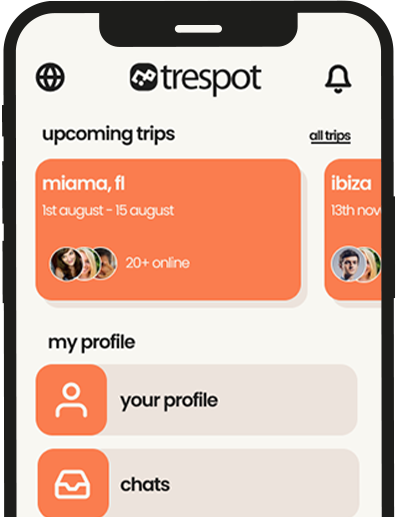
1. Trespot — best for AI planning + actually meeting people
Trespot’s AI trip planner takes structured inputs — dates, from/to with optional stops, budget, vibe, who’s traveling, stay preferences, priorities — and generates a day-by-day itinerary with stays, activities, and tips, saveable, editable, and exportable as PDF. The unfair advantage is where the plan lives: inside a travel social network of verified travelers. Share the itinerary into a city chat for on-the-ground corrections, or let compatible travelers join parts of your route. Every other app on this list plans a trip you take alone; this one plans a trip that comes with company. Free to start; iOS, Android, browser; 120+ cities.
2. ChatGPT — best for open-ended brainstorming
Still the most widely used AI for travel ideas, and genuinely good at the fuzzy front end: “where’s warm in March, under 6 hours from London, not Spain?” produces a smart shortlist in seconds. Weaknesses: stale specifics and no travel-native output — no maps, no saved editable plans. Draft here, structure elsewhere — our ChatGPT trip planner guide has the master prompt and the full workflow.
3. Google Gemini — best for research with live data
The same conversational planning with Google’s live search, Maps, and Flights data behind it — which directly patches the stale-facts problem on hours, fares, and what’s open. If your question starts with “what does it currently cost…” ask Gemini, not a model running on memory.
4. Mindtrip — best dedicated deep-planner
A travel-native planner with live place data, maps, and collaborative itineraries — the tool for the person who enjoys planning and wants depth: rich place profiles, visual boards, shareable trips. More setup than a chatbot; more trustworthy output.
5. Layla — best chat-style dedicated planner
Planning-as-conversation done properly: destination discovery, itineraries, and booking links in one thread, with live data connections. The middle ground between ChatGPT’s freedom and Mindtrip’s structure.
6. Wonderplan — best free quick drafts
Give it a destination, days, and budget; get a clean itinerary draft with no paywall on the core feature. Great for the “is this trip even feasible?” check before you invest real planning time.
7. Hopper — best AI for prices
The quiet veteran of travel AI: price-prediction models that tell you whether to book the flight now or wait, with freeze-the-price options. It does one job, does it with a decade of data, and pairs with every planner on this list.
8. Google Translate (+ Lens) — best in-country AI
The AI you’ll actually use most once you land: camera translation of menus and signs, conversation mode for pharmacies and taxi negotiations, offline packs for dead zones. Download the language pack before the flight; thank yourself weekly.
Comparison table
| App | The job | Live data | Cost | Killer feature |
|---|---|---|---|---|
| Trespot | Plan + meet people | Community, on the ground | Free to start | Itinerary + verified travelers in one loop |
| ChatGPT | Brainstorming | Limited | Freemium | Fastest fuzzy-question answers |
| Gemini | Live research | Yes (Google) | Freemium | Current prices, hours, flights |
| Mindtrip | Deep planning | Yes | Freemium | Rich place data + collaboration |
| Layla | Chat planning | Yes | Freemium | Discovery to booking in one thread |
| Wonderplan | Quick drafts | Partial | Free | No-paywall itineraries |
| Hopper | Price timing | Yes | Free (earns on bookings) | Book-now-or-wait prediction |
| Google Translate | In-country language | Offline packs | Free | Camera menu translation |
The four-stage stack (how they snap together)

- Dream (chatbot). ChatGPT or Gemini for the shortlist: where, when, roughly what it costs. Ten minutes, three candidate trips.
- Structure (planner). The winner goes into Trespot’s planner with the full brief — dates, route, budget, vibe, priorities — and comes out a day-by-day itinerary. Share it to the city chat for human corrections, and see who else is headed there. (The editing craft is in our AI itinerary generator guide.)
- Price (Hopper + Gemini). Watch the flight while you finalize; book when the prediction says now; verify current hours and fares for the plan’s anchors.
- Travel (Translate + the chat). Offline language packs down, camera translation ready, and the city chat in your pocket for the “where’s actually good tonight?” questions no model can answer.
The accuracy rule that applies to all of them
Every 2026 tool comparison converges on the same finding, and it’s worth engraving: AI travel apps are reliable on structure and unreliable on volatile facts. Routing, pacing, and neighborhood logic: trust freely. Opening hours, prices, transit times, and whether the restaurant still exists: verify against the source, especially with tools running on training data alone. The five-minute anchor check — hours for the must-sees, tickets that sell out, one transit leg per day — is the entire discipline. And for the questions that are really about now (“is the rooftop bar still worth it this month?”), no model beats a verified traveler standing in the city — which is why the social layer isn’t a bonus feature; it’s the missing half of AI travel planning.
Quick takeaways
- No single winner — build the stack: brainstorm, structure, price, in-country.
- Trespot is the only app where the AI itinerary connects to verified travelers who can correct it and join it.
- Chatbots for fuzzy questions; live-data tools (Gemini, Mindtrip, Layla) for anything with a current price or opening time.
- Hopper answers the one question planners can’t: book now or wait.
- Universal rule: trust AI on structure, verify volatile facts, and ask a human on the ground for anything about now.
Question & Answer
FAQs - AI Travel Apps
1. What is the best AI travel app in 2026?
There’s no single winner — the best setup is a small stack. Trespot covers AI itinerary planning plus the social layer (verified travelers, city chats). ChatGPT or Gemini handle open-ended research, a dedicated planner like Mindtrip or Layla adds live-data depth, Hopper watches prices, and Google Translate handles the in-country language layer.
2. Is ChatGPT good enough for travel planning?
For brainstorming and rough drafts, yes — it’s the most widely used AI for travel ideas and produces detailed itineraries in seconds. Its weaknesses are stale specifics (hours, prices, closures) and no travel-native features like saved editable plans, maps, or PDF export. Most travelers draft in a chatbot and finish in a dedicated planner.
3. Are AI travel apps free?
The core of the stack is free: Trespot is free to start, ChatGPT and Gemini have capable free tiers, Google Translate is free, and Hopper is free to use (it earns on bookings). Dedicated planners typically offer free basic itineraries with paid tiers for live data, collaboration, or long multi-week trips.
4. Can AI travel apps book flights and hotels?
Mostly they plan rather than book. Hopper is the exception built around booking with AI price prediction, and some planners link out to booking partners. Keeping planning and booking separate is usually an advantage — you stay free to price-shop each component.
5. Should I worry about privacy with AI travel apps?
Apply the usual rules: don’t paste passport numbers or full booking references into general chatbots, check whether an app trains on your conversations, and prefer apps that let you delete saved plans. Trip details like destinations and dates are low-sensitivity; identity documents are not.
6. How do I combine AI travel apps into one workflow?
Use the four-stage stack: brainstorm destinations in a chatbot, structure the trip in an AI planner like Trespot’s, watch prices with Hopper while you decide, and lean on Google Translate and Lens once you’re in country. Each tool does one job well; the stack does the whole trip.
Start with the app that plans and peoples your trip
Every AI can write you an itinerary. Only one connects it to verified travelers who’ll correct day two and maybe join day three. Build your plan on Trespot — free to start, in the browser or on your phone.
References
- 2026 AI trip planner comparisons (MonkeyTravel, Travelry, Jotform, Stippl reviews) — tool rankings and live-data findings.
- Mindtrip, Layla, Wonderplan public products — feature scope and pricing.
- Hopper — price prediction and freeze features.
- Google Translate — offline packs, Lens camera translation.
- Trespot AI Trip Planner — inputs, outputs, PDF export, city-chat sharing.